
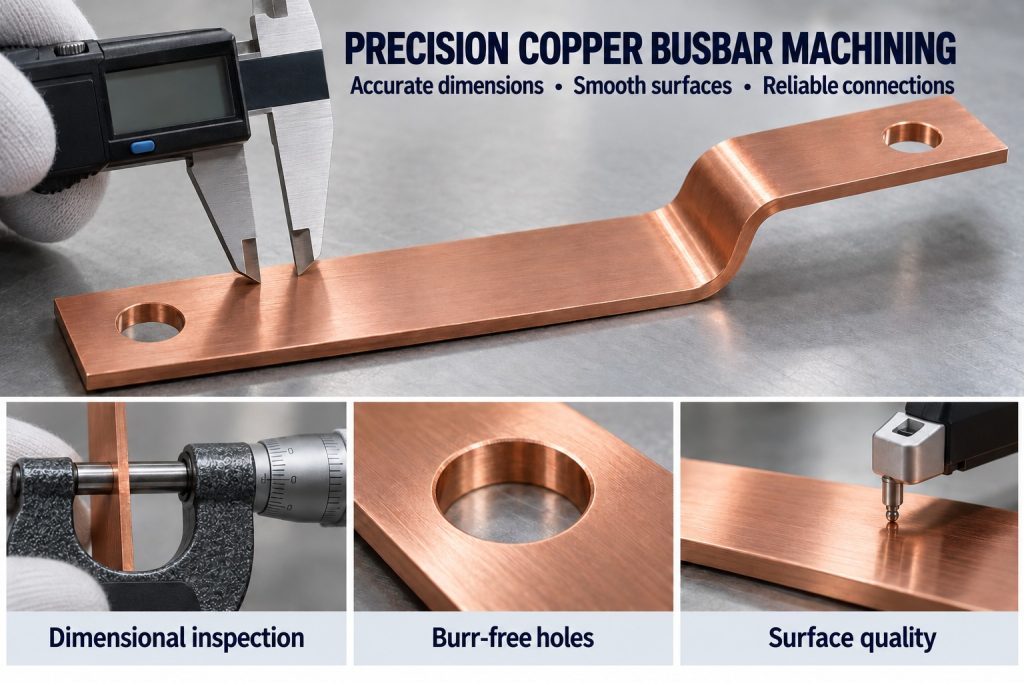
Copper busbars are essential electrical conductors used in switchboards, transformers, generators, and power distribution systems. Their high electrical conductivity and formability allow them to be processed for various applications. However, producing a quality component requires more than accurate dimensions. Every step, from cutting to surface cleaning, must be carried out carefully.
The first step is cutting the copper busbar to the length specified in the technical drawing. Saws or suitable cutting equipment can be used. The method depends on material thickness, width, and dimensional accuracy requirements. Burrs created during cutting are removed to ensure safe handling and smooth edges for subsequent operations.
Drilling prepares the connection points. Round holes are commonly used for bolted connections, while slotted holes allow adjustment during installation. Holes can be produced using drills, punches, or CNC machines. Correct hole diameters, centre distances, and edge distances are important for trouble-free assembly.
Bending transforms straight busbars into L-shaped, Z-shaped, or other connection geometries. The bending angle and inside radius are selected according to copper thickness, temper, and application. Unsuitable bending conditions can cause cracks, surface marks, or dimensional deviations. Appropriate tooling and controlled forming are therefore essential.
Some components require additional operations such as milling, slot machining, or tapping. These processes help create specialised connection details. Secure workpiece clamping and suitable cutting tools support dimensional accuracy and surface quality.
Surface treatment is another important production stage. Deburring, cleaning, and, where required, tin plating may be applied. Plating requirements depend on operating conditions and connection specifications. Clean, smooth contact surfaces support electrical connection performance.
Finally, dimensions, hole positions, bending angles, and surface condition are inspected. Installation compatibility, contact surface flatness, and specified tolerances are also checked. This reduces on-site rework. Properly processed simplify assembly and contribute to reliable connections. Well-planned production reduces material waste while delivering consistent quality.