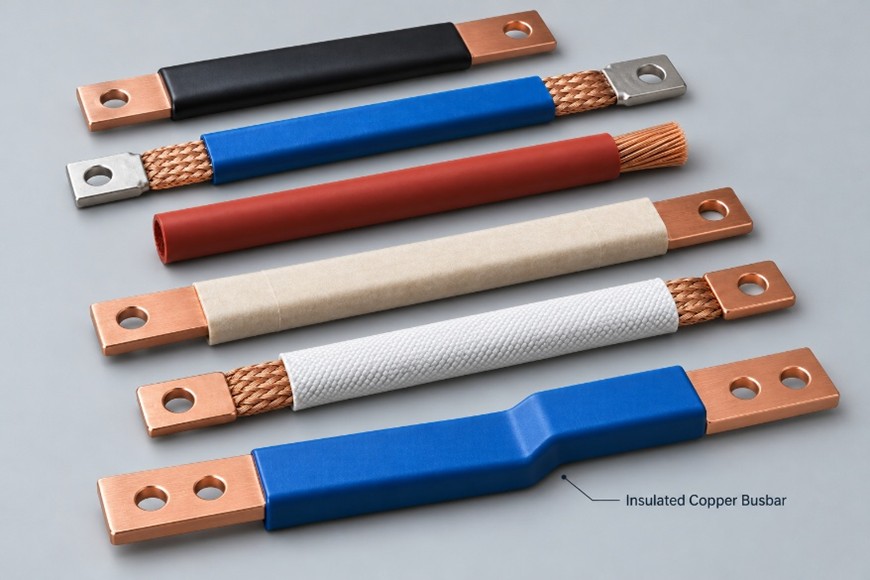
Reliable electrical connections depend on both conductor quality and insulation suited to operating conditions. Biba’s insulated solid copper busbars, flexible braided connectors and stranded cables combine conductive components with insulation options selected for each application.
For machined copper busbars, insulation covers the conductor body while designated contact surfaces and mounting holes remain exposed. Straight and bent configurations can accommodate equipment layouts, with insulation dimensions adapted to the bar geometry and assembly requirements.
PVC sleeves provide an economical, flexible option within their specified operating range. Heat-shrink tubing conforms closely to conductor profiles, creating a compact covering. Silicone sleeves are suitable where flexibility and temperature resistance are required. Electrical insulation paper can form part of transformer insulation systems, while glass-fibre sleeves offer options for demanding thermal environments. Their electrical performance depends on the coating and product specification.
Selection should consider operating voltage, temperature, movement, abrasion, moisture and chemical exposure. Insulation thickness, shrink ratio, bend geometry and exposed connection areas also require evaluation. Its effect on conductor heat dissipation must be considered when determining current capacity.
Matching insulation to the application helps protect Biba components and supports orderly installation. Appropriate material selection, accurate sizing and controlled application contribute to dependable connections across transformers, switchgear and industrial equipment.